
The Aegis Suit
A specialist solution to the combat rigors of extra-solar disagreements.

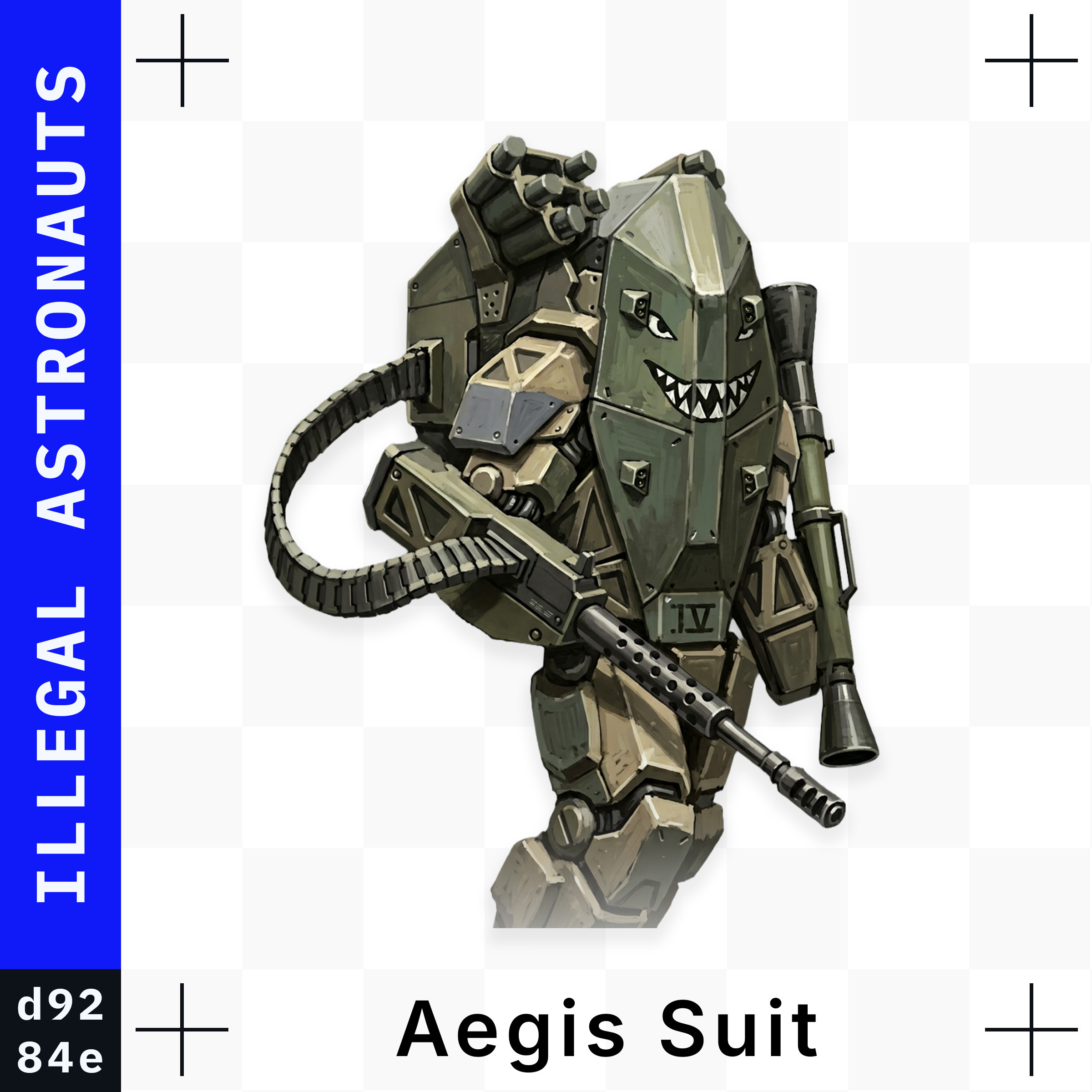
The Aegis Suit addresses a fundamental problem across all of human history:
How do I get heavy weapons into the hole my enemies are hiding in?
In a universe of confined space ship hallways, sprawling urban build up, and extra-solar mining tunnels with variable terrain, this problem is amplified. While FPV drones and other unmanned vehicles are effective at delivering payloads to remote locations, the benefit of a human on-site and thinking in the line of fire is not something to be ignored.
This is to say nothing about the psychological factor of a 6 ton metal monster lumbering towards your position laying down full-auto, 50. caliber hate as your small arms deflect off its carapace.
Of course, most Syndicate citizens will only ever see these lumbering 2.5 meter bipeds milling around and pulling security in, “high risk areas.” A task well suited to these armored assault suits as even a slow runner could out pace one of these units in a foot race. Though the pilot may have something to say about any runners with either the actuator mounted 50. Caliber heavy machine gun or its paired MUL-32e recoilless rifle.
Whatever the case, the Aegis Suit remains a specialist piece of hardware. Its whole premise is optimized for operation within confined, structured environments. Areas where traditional vehicles like classic Main Battle Tanks (MBTs) and other heavy armor vehicles cannot operate within. A key distinction from the early, failed, “walking tank,” mech suit designs.
The issue is one of mass. And while I won’t be diving into the mathematics here, it is suffice to say there is a Goldilocks Zone when it comes to the balance of form and function for something as eclectic as a bipedal machine. A line the Aegis Suit sits near center upon.
When it comes to purpose, the system is designed to supplement infantry firepower and draw small arms fire. It’s critical to note, if the Aegis Suit does come under fire from a 50. Caliber anti-material weapon, sustained grenade strikes, or anti-tank (AT) rounds, the suit will fail with a near-zero survivability rate for the pilot.
A huge loss for the cost of the equipment, but, also the investment dumped into the specialized pilot behind the controls.
While the loss of any soldier is a tragic cost to the social and financial structure of the Syndicate, an Aegis Suit pilot costs more than most. Beyond the standard training all Syndicate military personnel pursue, the Aegis Suit pilot is granted an additional 1 to 2 years of instruction on how to operate their machine. Though this is only done after the recovery period for the installation of the wired, neural jack system that’s fused into their skulls has elapsed.
With the combination of extensive training on a, “paired,” suit and the near instant, 1 to 1 feedback response afforded to the pilots from their neural jack connection, the Aegis Suits remains a significant threat to hostile forces in ship-borne, extra-solar, and hyper-dense urban settings.
That is to say, in the environments where the Aegis Suit is intended to be deployed, the weapon system excels. This is in part because no one in their right mind is going to unlimber an AT weapon within a space ship; though records persist that suits have been lost to this before.
Outside of these bounds, like if, for example, you were to deploy a suit into an open field, the benefits of the Aegis Suit over classical military hardware, like MBTs, fades faster than a new hire on Dancer’s Avenue.
To conclude, the Aegis Suit is a hyper-specialized, supplemental, light armor unit designed to provide security and lead assaults in confined, structured environments whether they be the hallways of an Outcast spin ship, the tunnels of a pirate mining complex, or the back alleys of Uruk’s sub-layers.
I’ve never piloted one, but I’d certainly like to try.
Charlie Berkins
Galaxy.NET Historiographer, Military Studies
All opinions, biases, fallacies, incorrect information, and similar information that can be gleaned, interpreted, or believed to be understood from this document is the responsibility of the indicated historiographer (Charlie Berkins) and is in no means, convention, or intention a representation of the beliefs of Galaxy.NET or its subsidiaries.
All information as presented in this document is the sole property of Galaxy.NET.